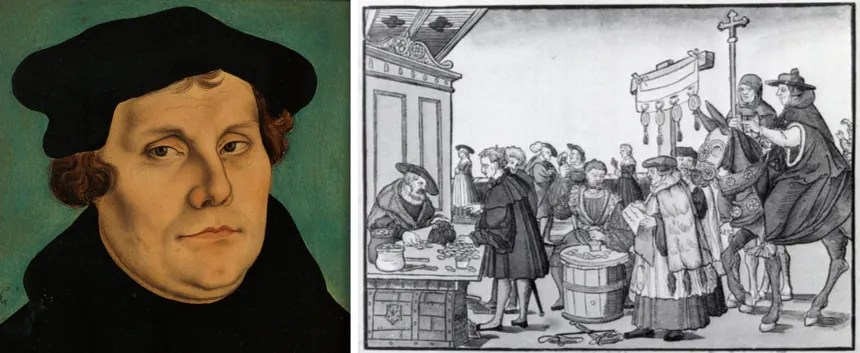
Martin Luther (1483-1546) was a German theologian and a major leader of the Protestant Reformation. He is sometimes called the father of Protestantism, and one of the major branches of “main-line” Protestantism — Lutheranism — is named after him. Luther was the son of a Saxon miner. He entered the University of Erfurt when he was 18 years old. After graduation, he began to study law in 1505. In July of that year, however, he narrowly escaped death in a thunderstorm and vowed to become a monk. He entered the monastery of the Augustinian Hermits at Erfurt, where he was ordained in 1507. The following year he was sent to Wittenberg, where he continued his studies and lectured in moral philosophy. In 1511, he received his doctorate in theology and an appointment as professor of Scripture, which he held for the rest of his life. Luther visited Rome in 1510 on business for his order and was shocked to find corruption in high ecclesiastical places in the Roman Catholic Church.
He was well acquainted with the scholastic theology of his day, but he made the study of the Bible, especially the epistles of Paul, the center of his work. Luther found that his teachings diverged increasingly from the traditional beliefs of the Roman church. His studies had supposedly led him to the conclusion that Christ was the sole mediator between God and man and that forgiveness of sin and salvation are effected by God’s grace alone (sola gratia) and are received by faith alone (sola fide) on the part of man. This point of view supposedly turned him against scholastic theology, which had emphasized man’s role in his own salvation, and against many church practices that emphasized justification by good works. (We say “supposedly” because in his Small Catechism of 1529, Luther clearly denies grace alone and faith alone in favor of adding baptism and the sacraments.)His approach to theology soon led to a clash between Luther and church officials, precipitating the dramatic events of the Reformation.
The doctrine of Indulgences, with its worldly view of sin and repentance, became the specific focus of Luther’s indignation. The sale by the church of indulgences — the remission of temporal punishments for sins committed and confessed to a priest through the payment of money — brought in much revenue. The archbishop of Mainz sponsored such a sale in 1517 to pay the pope for his appointment to Mainz and for the construction of Saint Peter’s in Rome. Luther posted his famous 95 theses on the door of the castle church at Wittenberg on October 31, 1517. Although some of the theses directly criticized papal policies, they were put forward only as tentative objections for discussion.
In 1520, Luther completed three celebrated works in which he stated his views. In his Address to the Christian Nobility of the German Nation, he invited the German princes to take the reform of the church into their own hands; in A Prelude Concerning the Babylonian Captivity of the Church, he attacked the papacy and the current theology of sacraments; and in On the Freedom of a Christian Man, he stated his position on justification and good works. The bull of Pope Leo X, Exsurge Domine, issued on June 15 that same year, gave Luther 60 days to recant, and Decet Romanum Pontificem, of Jan. 3, 1521, excommunicated him.
His reforming work during subsequent years included the writing of the Small and Large Catechisms, sermon books, more than a dozen hymns, over 100 volumes of tracts, treatises, Biblical commentaries, thousands of letters, and the translation of the entire Bible into German. Luther’s failure to reach doctrinal accord with Ulrich Zwingli on the nature of the Eucharist (1529) split the Reform movement.
Nonetheless, Luther found personal solace in his marriage (1525) to a former Cistercian nun, Katherina von Bora; they raised six children. (Adapted and/or excerpted from Funk & Wagnall’s New Encyclopedia, Webster’s New Biographical Dictionary, and Grolier’s Electronic Encyclopedia.)
 Living as a Christian in this World