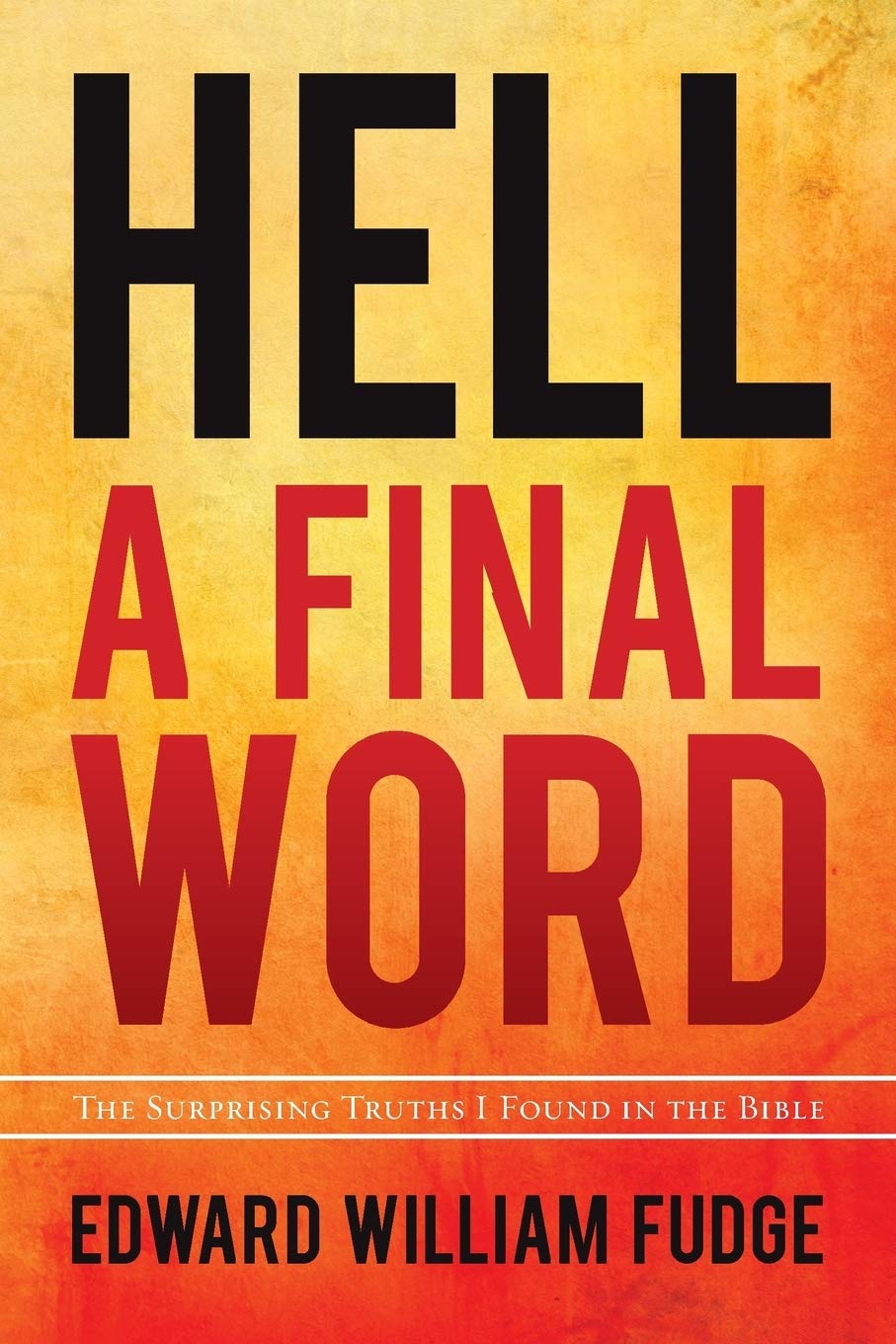
The following has been extracted from Edward Fudge’s book Hell: A Final Word
Blame it on the King James Version if you wish. The dangling fruit was so beautiful and far too close to resist. Imagine that you are a preacher and you have been requested to present a sermon on hell—“for the young folks,” the requester explains. “Not blaming you, of course, but some members of their generation have never heard an old-fashioned, true-blue, fire-and-brimstone sermon on hell.” You flip through your favorite reading Bible. The Old Testament does not mention final hell, you remember. Wherever the word “hell” creeps into the English Old Testament, it always translates sheol, the Hebrew word for the unseen realm of the dead. It has nothing to do with punishment in the Old Testament—good and bad people all finally land there.
The Old Testament never mentions hell as the place where the ungodly will suffer eternal punishment. The New Testament presents its own set of problems. Your concordance of Greek words reminds you that gehenna, the word for “hell” as final punishment, appears only twelve times in the whole New Testament. One of those is in James, where it is not talking about final punishment at all. The other eleven usages are all in the Gospels. All are spoken by Jesus to Jews who live in or around Jerusalem. As odd as it seems to us, if the New Testament reflects a typical picture of the word’s usage, most of the early church might never have heard the word for “hell” at all. Then it happens! As you skim through the Gospel of Luke, your eyes strike a word here, a phrase there. Soon you are too entangled to go anywhere else. It is the parable of the Rich Man and Lazarus. The beggar Lazarus is laid at the gate of the rich man, who ignores him—while he himself banquets daily. This is how the story opens, as told in the King James Version.
Luke 16:19 There was a certain rich man, which was clothed in purple and fine linen, and fared sumptuously every day: 20 And there was a certain beggar named Lazarus, which was laid at his gate, full of sores, 21 And desiring to be fed with the crumbs which fell from the rich man’s table: moreover the dogs came and licked his sores. Then both men die and their positions somehow reverse. 22 And it came to pass, that the beggar died, and was carried by the angels into Abraham’s bosom: the rich man also died, and was buried; 23 And in hell he lift up his eyes, being in torments, and seeth Abraham afar off, and Lazarus in his bosom.
Finally the rich man asks Abraham for a favor. Luke 16:24 And he cried and said, Father Abraham, have mercy on me, and send Lazarus, that he may dip the tip of his finger in water, and cool my tongue; for I am tormented in this flame.
There you have it. Jesus says that the rich man dies, is in hell, and is in torment. The rich man seeks mercy because he is tormented in a flame. How could it be more obvious? With all this to work from, a sermon is not long in coming. When bad people die, the audience is assured, they go to hell where they are tormented in fire forever. And our authority is no less than Jesus himself.
But perhaps this conclusion is a bit hasty. For closer investigation reveals some interesting facts, as we will now observe.
Let’s think through four details about this story Jesus told and be sure we are not about to misuse it ourselves. Those four details concern its form (parable, not history), its purpose (the context concerns subjects not related to final judgment and hell), its setting (here and now), and its intended mode (figurative or literal). Parable, not factual narrative The story of the rich man and Lazarus is not a factual narrative, but a borrowed parable. Parables usually teach one over-all lesson, sometimes two.
The fact that Jesus used the parable does not mean that he endorsed all its details. Some object that this story cannot be a parable because it begins with the words “there was a certain rich man” and “there was a certain beggar.” In fact, it is just as likely that the quoted words mark the story as a parable. Two chapters later, Luke introduces another story with the words: “Now he told them a parable,” leaving no doubt about the literary character of the story (Luke 18:1). Jesus then continues with the same kind of specific identification he uses in our story. “In a certain city there was a judge . . . and there was a widow in that city” (Luke 18:1-3).
It is clear that mere specificity of detail does not mean a story is not a parable or that it is actually true. In this case, the parable probably is not original with Jesus, but is one Jesus has borrowed from the rabbis. According to a 1966 doctoral dissertation, at least seven versions of this parable have been found in literature of the period. Jesus simply borrows a tale from his surroundings, changing some details to make his point. This fact caused Robert A. Morey, a strong defender of the traditional view of hell, to conclude that this story does not provide us literal details of the world to come. Context concerns different subjects Perhaps more important, if we read the Parable of the Rich Man and Lazarus in its context, we will see that the story’s themes have nothing to do with hell or with the nature of final punishment.
In Luke 16:1-13, Jesus teaches about the importance of stewardship. The Pharisees, who are covetous, mock Jesus and his teaching (Luke 16:14). Jesus warns the Pharisees that God sees the hearts and views people differently from their fellow mortals. He cautions that the times are critical and that people should not waste opportunity to obey God (Luke 16:15-18). Then Jesus tells this parable that illustrates all his points. It is a story of a covetous man who ignores his responsibilities toward Lazarus as a steward of God’s wealth. He is honored by people but God has a different view. And, after dying, the covetous man realizes too late that he has wasted his opportunity to obey God. The parable fits the context precisely and the themes they share in common reveal Jesus’ purposes in telling this story. Here and now, not future eternity Besides all that, the details of this story occur here and now, not in eternity beyond the present age. While the rich man is agonizing in hades, his five brothers are still living on earth. I would like to say “living it up,” but the text does not say that.
However, the dead man seems to assume that his brothers view their possessions, as he also had done, in terms of self and not as God’s possessions, entrusted to them to manage on God’s behalf. It is all about stewardship. Not only are the brothers still living during the present age, they live before Jesus’ resurrection and while Moses and the prophets are God’s latest word (Luke 16:29-31).
This is important to the parable itself, because it sets up the story for its punch-line. The rich man asks Abraham to send Lazarus to warn his five brothers. Abraham denies the request, saying they should listen to Moses and the prophets. The rich man replies that they would listen to someone who returned back from the dead. Abraham disagrees. If they ignore Moses and the prophets in Scriptures read weekly in synagogue, they will ignore someone back from the dead (Luke 16:27-31). Abraham proves to be correct. For Jesus himself will soon be killed, then rise from the dead, and the Pharisees who mock his teaching now will have the same attitude toward Jesus still. But our eyes are on something different. In the story of the rich man and Lazarus, the action takes place now, not after judgment at the end of this age.
People do not go to hell before they are judged. Final judgment happens after Jesus’ final coming. The rich man in this story is not in Gehenna, the place of final punishment. He is in hades, the unseen realm of the dead, the place called sheol in the Old Testament. In fact, the “hell” in this story in the King James Version, the “hell” that has caught so many eyes and captured so many imaginations through the centuries, is not the hell of final punishment at all. It is simply hades, sheol, gravedom, the unseen realm of the dead. If the parable proved anything about post-mortem circumstances, it would still say nothing about final punishment in hell or Gehenna. Not literal.
Finally, the parable should not be read literally, as if a literal reading contained Jesus’ intended message. That would require one to believe:
• That Abraham receives the godly dead and remains with them;
• That angels transport the godly dead from earth to Abraham;
• That the godly and ungodly, though apart, are both audible and visible to each other;
• That a single drop of water would relieve the pain of the lost;
• That the saved can theoretically travel to the unsaved, or even to earth.
In fact, I have never met, heard, or read anyone who consistently interpreted the story of the rich man and Lazarus literally in every detail. It is not hard to understand why. The story of the rich man and Lazarus is a parable, not historical narrative. The context shows its subject something other than heaven and hell. Its setting is a time during ongoing earthly history and before Jesus is raised from the dead. And even if that were otherwise, it is not intended to be taken literally.
This is a story of the sort named “parable.” It is a teaching tool about the urgency of obeying God in caring for the poor and a reminder that opportunity for doing that is running out. It says nothing at all about gehenna, the “hell” of final punishment. At most, this story is set in hades, before the judgment, while life on earth continues with its usual covetous ways.
By Fudge, Edward William. Hell A Final Word . Leafwood Publishers.
 Living as a Christian in this World