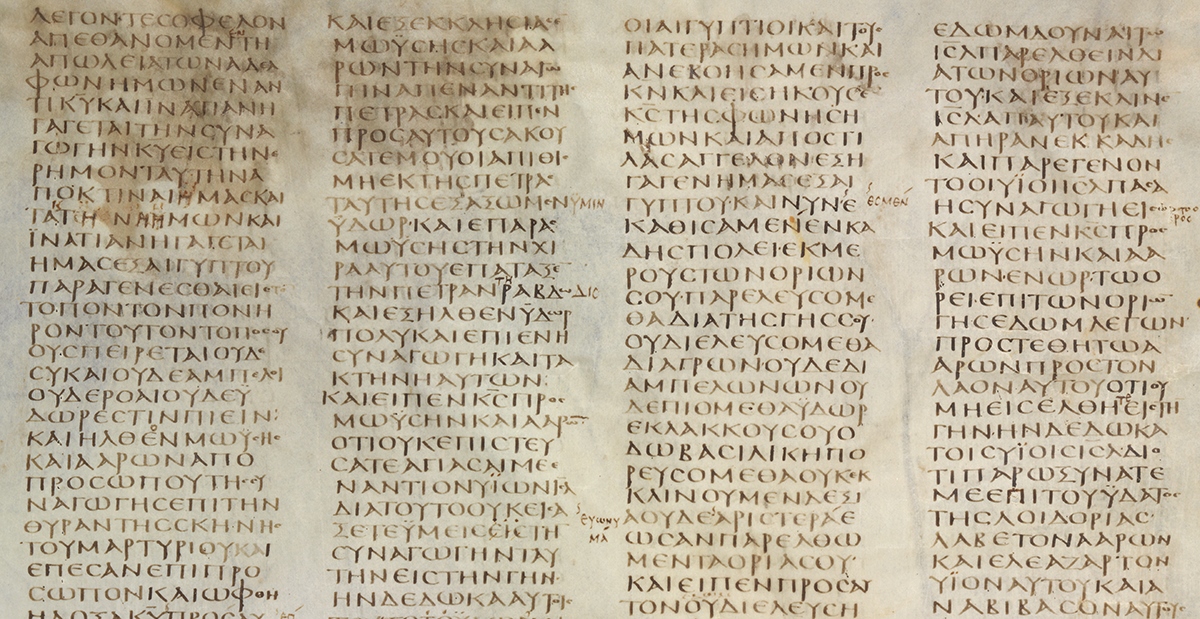
In general they state that ancient languages were not punctuated. In Aristotle’s day, the only known punctuation was a line to indicate when a new topic would follow. It indicated what we would call a new paragraph.
Most sources state that the Greek language had no punctuation until the Second Century AD. If true, this means that when the apostles wrote the letters and books which were later compiled into the New Testament, they wrote without any spaces or punctuation. Koine Greek originally had an alphabet of only capital letters (uncials), without any spacing between words. Lower case letters (miniscules) were developed around the 9th Century.
According to Porter et al (2010), New Testament Greek punctuation wasn’t found in any consistent form before the 6th Century. Daniel Wallace (Greek New Testament Expert) points out that the absence of dictionaries meant there were various types of spellings for the same word – anything went, which is one reason why you get spelling variations in New Testament manuscripts (i.e. scribal copies of the original autographs). Perhaps the same could be true for punctuation? If there wasn’t a set rule, perhaps some copyists used punctuation, while the majority didn’t.
Porter et al writes:
“Edited texts of the Greek New Testament do not always agree on punctuation. In fact, the two major editions — the Nestle-Aland (27th ed.) and the UBSGNT (3rd and 4th eds.) — have essentially the same printed text but in some cases different punctuation. Punctuation is used to indicate whether certain clauses are questions or statements, or to indicate when major and minor breaks occur. It is an addition to the original text not found consistently or in quantity before the sixth century a.d.
Hence there is room for editors to disagree on punctuation, although in some instances grammar can help make this decision. The four punctuation marks are period (.), which indicates a complete break between sentences, as it does in English; comma (,), which indicates a minor break between phrases or clauses, also as in English; raised dot, or colon (·), which indicates an intermediate-level break, somewhat equivalent to the English semicolon or colon; and question mark (;), which looks like an English semicolon.” (Page 14) Emphasis added.
The Wikipedia page on Koine Greek shows an image of Papyrus 46, one of the oldest New Testament manuscripts we have. If you enlarge it, you’ll see that there are no spaces or punctuation markers. The image can be found at https://en.wikipedia.org/wiki/Koine_Greek
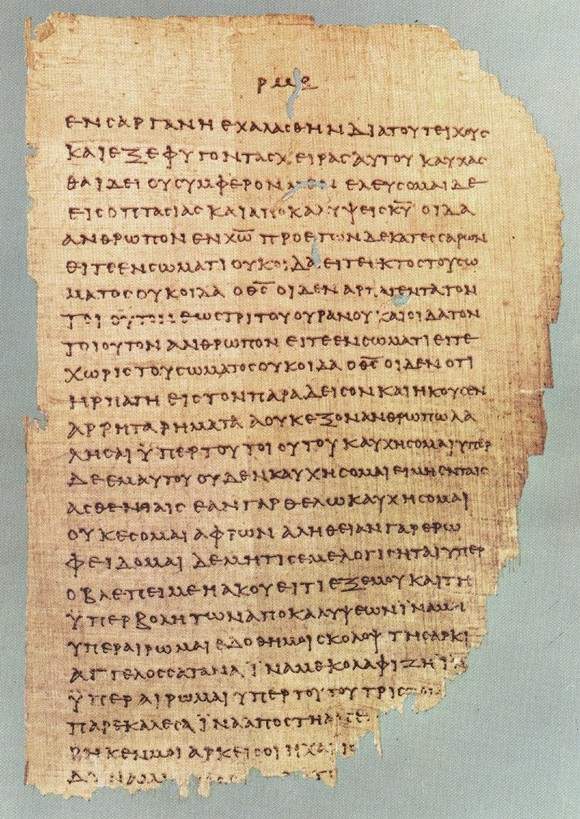
Many Christians are unaware that what we see in our English Bibles with punctuation and capitals is NOT how they wrote in bible times. So god is not written as “GOD” or “God”.
For example ,it is clear that the ancient Greeks did not have a system of punctuation similar to modern English. The snippets from “Punctuation in Ancient Greek Texts, Part I” and “Punctuation in Ancient Greek Texts, Part II” confirm that sentence punctuation was invented several centuries after the time of Christ.
In fact, the earliest manuscripts of biblical texts, such as Codex Sinaiticus, did not contain punctuation. Instead, competent readers of Ancient Greek would have relied on context and syntax to understand the intended meaning.
The absence of punctuation in ancient Greek texts is also reflected in the description of the Greek alphabet in “Ancient Greek/Alphabet” from Wikibooks, which notes that the Greeks themselves wrote only in capitals, without punctuation.
Timeline
- 9th century BC: Adoption of the Greek alphabet
- Ancient Greek period (5th century BC – 4th century AD): No punctuation system
- Several centuries after the time of Christ (exact date unknown): Sentence punctuation was invented
In summary, the Greek language did not have a punctuation system during the ancient period. Punctuation was introduced much later. Please see attached image as an example.
This means that when the apostles wrote the letters and books which were later compiled into the New Testament, they wrote without any spaces or punctuation. Koine Greek originally had an alphabet of only capital letters (uncials), without any spacing between words. Lower case letters (miniscules) were developed around the 9th Century.
According to Porter et al (2010), New Testament Greek punctuation wasn’t found in any consistent form before the 6th Century. Daniel Wallace (Greek New Testament Expert) points out that the absence of dictionaries meant there were various types of spellings for the same word – anything went, which is one reason why you get spelling variations in New Testament manuscripts (i.e. scribal copies of the original autographs). Perhaps the same could be true for punctuation? If there wasn’t a set rule, perhaps some copyists used punctuation, while the majority didn’t.
So it is important to understand that when we read our bibles the translators had to decide what to make a capital and where to put punctuation to make it more readable. This obviously leads to a bias, based on the background and understanding of the translators.
 Living as a Christian in this World