We stated in the introduction that Calvinism has its roots in the views of St. Augustine. This man was also largely responsible for the acceptance of a-millennialism into mainstream Christianity, and the Roman Catholic doctrine that the Catholic Church is now God's Kingdom on earth. Prior to his conversion in the fourth century, Augustine was … Continue reading 10. Free Will & the Early Church – Calvinism
Category: Christian Doctrines
6. God’s Will – Calvinism
God's will is that believers obstain from fornication. Paul wrote, "For this is the will of God, your sanctification: that you should abstain from sexual immorality; that each of you should know how to possess his own vessel in sanctification and honor, not in passion of lust, like the Gentiles who do not know God; that no … Continue reading 6. God’s Will – Calvinism
9. Where Calvinism Leads
When the philosophy that drives Calvinism is projected to its logical conclusion, even Satan's activity is an extension of God's sovereignty. God sovereignly controls Satan's every move. This makes God the author of everything evil, and the most wicked sinner of all. Some Calvinists actually admit this, and seek to defend it from Scripture. If … Continue reading 9. Where Calvinism Leads
4. Irresistible Grace – Calvinism
Grace According to CalvinistsCalvinists do not deny that God's grace is given to the non-elect. Everything good is from God. Jesus said that God makes the sun to shine on both the wicked and righteous. Everything good in this world is because of the grace of God. However, Calvinists distinguish between what they call "common … Continue reading 4. Irresistible Grace – Calvinism
5. Perseverance of the Saints – Calvinism
It may come as a surprise to many Christians that "Eternal Security" (or once saved always saved) was completely unknown to the Church prior to the development of Calvinism during the Reformation. Even St. Augustine, whose philosophies led to the development of Calvinism, did not hold to "Eternal Security." The Scriptures teach that the believer … Continue reading 5. Perseverance of the Saints – Calvinism
2. Unconditional Election Calvinism
Calvinists believe God has chosen only certain individuals to be saved, based entirely on His sovereignty. By this they mean that God does not take into consideration any future faith or response to His grace by the individual. Rather, He decides whom He will save completely independently of man's own will. Since mankind is allegedly … Continue reading 2. Unconditional Election Calvinism
3. Limited Atonement – Calvinism
Calvinists take their theory to the next logical plateau, by claiming the blood atonement of Christ was limited to the elect only. Christ died only for the sins of the elect. If one is not elect, Christ did not die for his sins. Support for this idea is derived from passages that speak of Jesus' … Continue reading 3. Limited Atonement – Calvinism
1. Total Depravity – Calvinism
The Human Condition According to Calvinists The Calvinist view of the human condition is one of complete and utter depravity. They do not deny that man sometimes does things that are good. However, his fallen condition makes it utterly impossible for him to live righteously. He inevitably gives in to his fallen nature inherited from … Continue reading 1. Total Depravity – Calvinism
0. An Introduction to Calvinism
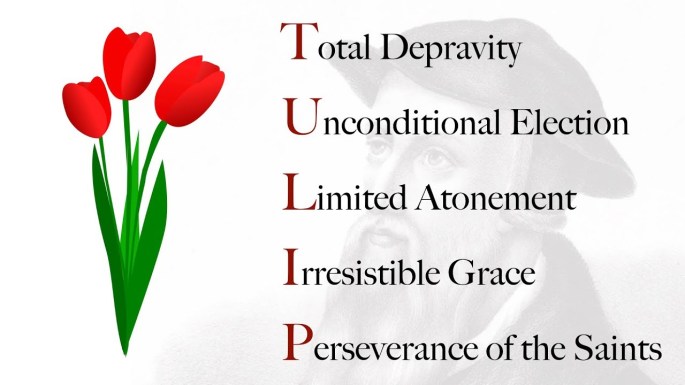
The system known as "Calvinism" (or Reformed Theology) has its roots in the writings of St. Augustine in the 4th century. Church historian, Philip Schaff, documents St. Augustine's beliefs in his introduction to the works of St. Augustine. "Augustin...asserts that divine grace is not conditioned on human worthiness, and maintains the doctrine of absolute predestination, … Continue reading 0. An Introduction to Calvinism
How Plato Influenced Our View of God!
Many Christians believe that their view of God is derived solely from the Bible. We would never suspect that the roots of our belief in a triune God comes, not from Scripture, but from Greek philosophy. Nor could we imagine that the respected early Church Fathers were to blame for synthesizing pagan philosophy, such as … Continue reading How Plato Influenced Our View of God!