I have put together an important teaching showing that we do not go to heaven or hell when we die.
One of the key points is that Greek philosophy and myths taught a different concept about death by using the term Hades.
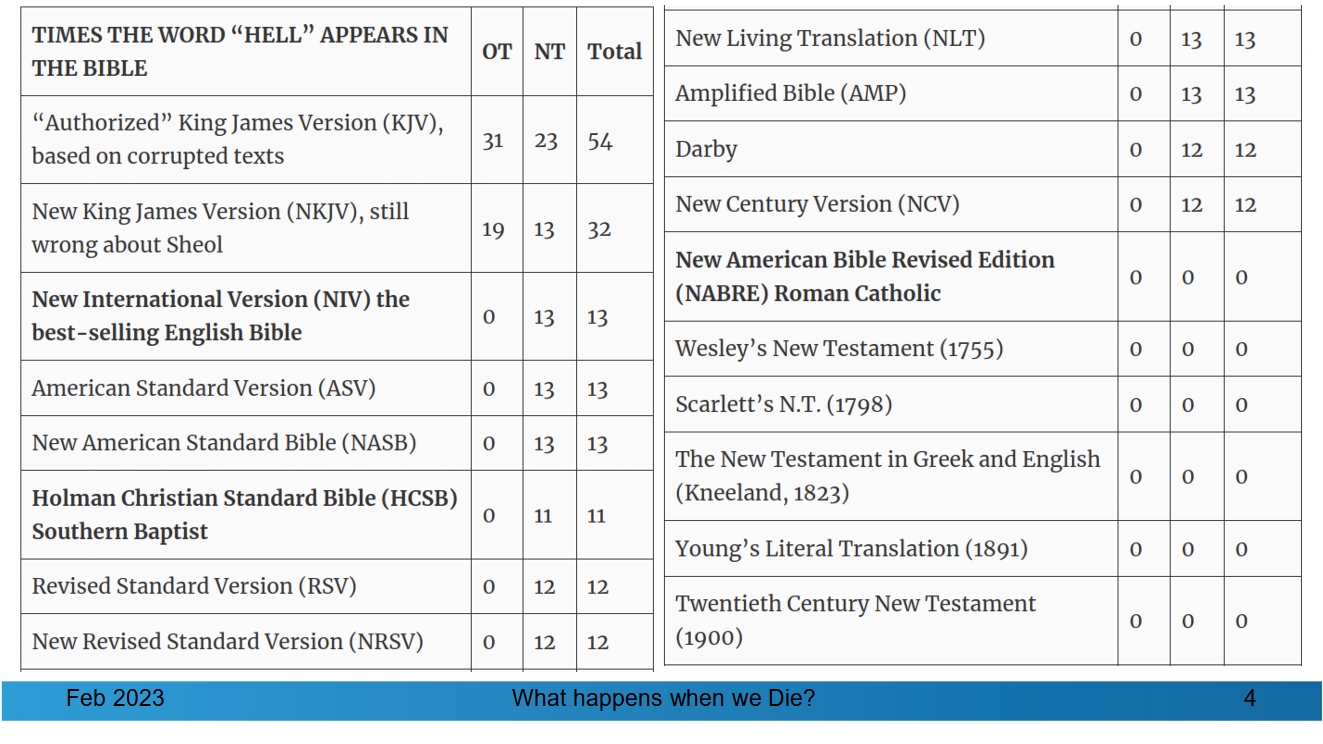
The Jews never had a view of burning in hell forever. Our translations have misled us especially the KJV and NKJV.
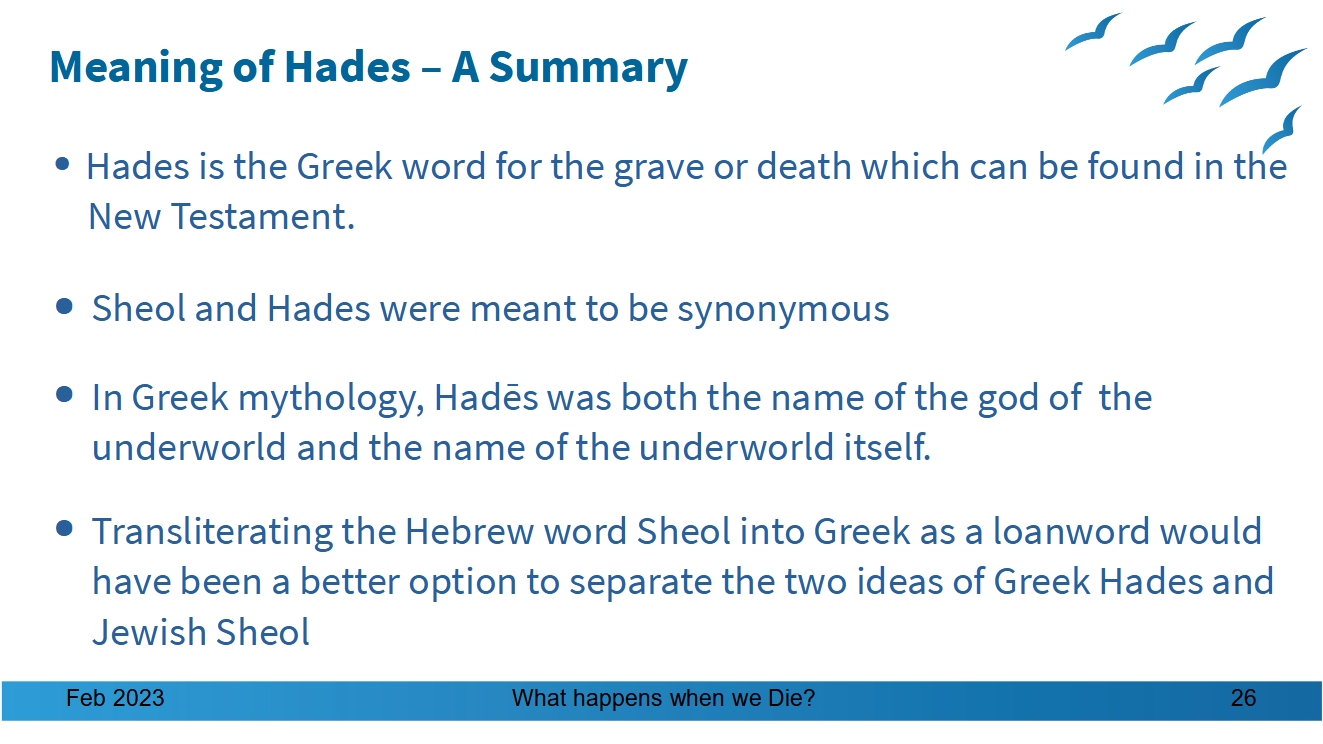
Here is an explanation of what happened to alter the meaning of Hades in the Jews eyes. The Hebrew word Shoel which is in the OT was translated to Hades in the Greek Old Testament, which impacted the understanding completely.
Alexander the Great arrived in Egypt in 332 BC. After defeating the Persian emperor Darius for control of Syria, Alexander marched to Egypt and found the Egyptians ready to throw off the oppressive control of the Persians. Alexander was welcomed by the Egyptians as a liberator and took the country without a battle.
This led to the Egyptians including the Jewish inhabitants to embraced Greek culture and their language.
In Greek mythology, Hadēs was both the name of the god of the underworld and the name of the underworld itself. So when the Hebrew Old Testament was translated into Greek around 250 BC, the Septuagint translators translated the Hebrew word Sheol into the Greek word Hadēs in a number of cases, but not all.
Greek mythology had stories of people being alive in Hadēs. So when the Greek-speaking Jews in Egypt translated Sheol as Hadēs, by the stroke of a pen they turned dead people into living people, and this introduced great confusion about the state of the dead into Judaism and then into Christianity.
That confusion continued and perhaps was exacerbated when the New Testament books of Matthew, Luke, Acts, Corinthians, and Revelation used the word Hadēs. Although the New Testament use of Hadēs was the same as its use in the Septuagint, it is understandable that most Greeks would have seen Hadēs in light of the traditional mythology, and believed that the god Hadēs (the Devil) lived in Hadēs and reigned over the people there.
So today millions of Christians believe that the souls of dead people are alive and suffering in “Hell” (Hadēs) because of what came from Greek mythology into Christianity.
Hadēs like Sheol was supposed to be connected with death; but never with life; always with dead people; but never with the living.
Meaning all in Hadēs will “not live again” until they are raised from the dead (Revelation 20:5).
The English word “hell” by no means represents the Greek word Hadēs; as we have seen that it does not give a correct idea of its Hebrew equivalent, Sheol. Hadēs in the minds of Greeks was a place of torment and is nothing like Sheol.
The word Hadēs occurs in the Greek New Testament 10 times and it always refers to the state of being dead or the state of non-existence except once in Luke 16:23.
In that passage, Jesus uses Hadēs in the same way that his Pharisee audience was using it—to refer to a place of the living dead. The Pharisees were one of the Jewish groups that took on the Greek belief that some of the humans who had died were alive in Hadēs, which explains why Jesus framed his parable of the rich man and Lazarus the way he did (Luke 16:23).
Why would the Greek-speaking Jews translate Sheol as Hadēs?
It is possible that some of the Jews had become so Hellenized that they thought that the dead were alive in Hadēs and felt that Hadēs was a good translation of Sheol.
It is also possible that they used Hadēs because they did not have a Greek word that had the same meaning as Sheol. The Greeks believed that the human soul was immortal, and so they did not have a vocabulary word that was the equivalent of Sheol which meant “the state of being dead.”
Whatever the case, the Septuagint translators chose to use the Greek word Hadēs as a translation of Sheol.
To maintain the proper theology of the Bible, it would have been better if they had simply transliterated Sheol into Greek and brought it into the Greek language as a loanword.
Actually, that is what David Stern does in his Complete Jewish Bible. When Hadēs occurs in the Greek New Testament, Stern translates it Sheol.
 Living as a Christian in this World