The 53rd chapter of Isaiah emphasizes the sacrifice of Christ, linking spiritual salvation to physical healing. The author argues that Jesus' atonement addresses both sin and sickness, promoting faith as essential for healing. Miracles are accessible to all believers, not just ministers, and divine healing aligns with God's will. The text asserts that sickness is of the devil, and believers must actively resist it while embracing God's healing promises.
Tag: bible
The Rich Man and Lazarus by Edward Fudge
The following has been extracted from Edward Fudge's book Hell: A Final Word Blame it on the King James Version if you wish. The dangling fruit was so beautiful and far too close to resist. Imagine that you are a preacher and you have been requested to present a sermon on hell—“for the young folks,” … Continue reading The Rich Man and Lazarus by Edward Fudge
Shaliah – Jewish Law of Agency
John 17:18 NASB You sent Me into the world, I also have sent them into the world. Sent – The Jewish law of agency, known as shaliah, is crucial for understanding the idea of an apostle. In fact, the verb itself, apostéllō, used here to speak of the mission of Yeshua and the mission of … Continue reading Shaliah – Jewish Law of Agency
Defining Elohim in the Biblical Context
by Paul Sumner hebrew-streams.org The word most often used for God in the Hebrew Bible is Elohim. The word is a topic of frequent theological discussion and defining. But what is often lacking is accurate and detailed information based on the biblical contexts in which the word is found. Elohim Section A — Summary of … Continue reading Defining Elohim in the Biblical Context
Philosophy & Methodology for Understanding Scripture
By Tim WarnerCopyright © The Pristine Faith Restoration Society The Pristine Faith Restoration Society believes that the foundational philosophies for discovering God's truth of the Catholic, Orthodox, and Protestant Churches are all seriously flawed. We realize that every Christian organization and denomination claims to hold to the original Christian Faith. But, with the extensive variety … Continue reading Philosophy & Methodology for Understanding Scripture
Life, Death and Resurrection in the Pauline Epistles
Acts 24:21 unless it is for this one statement which I cried out, standing among them, 'Concerning the resurrection of the dead I am being judged by you this day.' Many verses in Paul's epistles are often cited to prove he taught that man has an immortal soul which would depart upon the death of … Continue reading Life, Death and Resurrection in the Pauline Epistles
“Melchizedek” is the Son of God
Christian interpreters have long been puzzled by the brief mention of Melchizedek in Genesis 14, his one-sentence mention in Psalm 110:4, and by the interpretation of those two texts by Paul in Hebrews 5&7. Most Christian commentators hold that Melchizedek was just a man and that he merely prefigured Christ, being a type or comparative … Continue reading “Melchizedek” is the Son of God
The Coexistence of Sovereignty and Free Will – Calvinism Series
God is sovereign, but that doesn’t lead to the philosophy of St. Augustine or John Calvin. God chooses to limit His sovereignty in the case of man’s free will. He has established a framework of natural laws and spiritual laws. His natural laws include the laws of physics. Everything in the universe obeys God’s natural … Continue reading The Coexistence of Sovereignty and Free Will – Calvinism Series
Free Will & the Early Church – Calvinism – Part 11
We stated in the introduction that Calvinism has its roots in the views of St. Augustine. This man was also largely responsible for the acceptance of amillennialism into mainstream Christianity, and the Roman Catholic doctrine that the Catholic Church is now God’s Kingdom on earth. Prior to his conversion in the fourth century, Augustine was … Continue reading Free Will & the Early Church – Calvinism – Part 11
Biblical Chronology Introduction
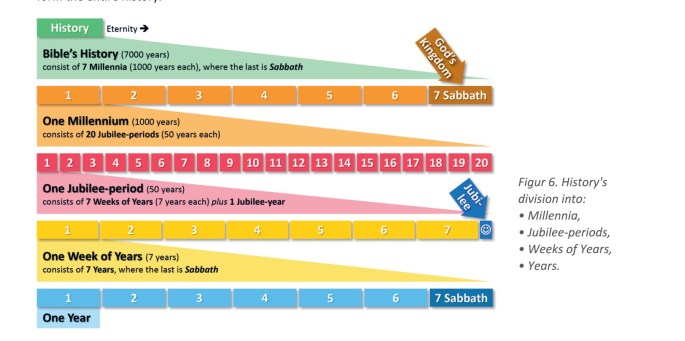
The earliest Christians with links to the Apostles were Millennialists (Chiliasts), claiming that Jesus would return to earth to establish His one-thousand-year Kingdom after six millennia had elapsed from creation. The Psalm of Moses (Psalm 90), 2 Peter, Hebrews, and Revelation contain strong evidence that this was apostolic teaching. If so, all that is necessary … Continue reading Biblical Chronology Introduction