“Whoever” Individually versus “The Whole” Collectively

The New Testament contains a common, theologically significant, expression which is incorrectly translated in most English versions. This provides false implications which affect more than one theological point. The expression πᾶς + substantive singular participle is translated either as “whoever believes,” , “whoever is born/begotten” (of God, or of the Spirit), or “whoever loves.” 1. The expression πᾶς ὁ πιστεύων (“whoever believes”) appears in … Continue reading “Whoever” Individually versus “The Whole” Collectively

Seven Age Dispensationalism

To say that the appearance of the Scofield Reference Bible  in 1909 caused a dramatic change in evangelical Christianity would be an understatement. Many have studied its footnotes with great care, almost giving them an authority equal to the biblical text itself. Anyone who dares raise any question about its teachings is immediately called a “liberal,” … Continue reading Seven Age Dispensationalism

Is God’s Spirit is a Person?

The following is an interaction on a Christian forum between two men whose names I have changed. It shows how Greek is quite different to English. In Greek grammar all nouns are categorised into three grammatical genders: masculine, feminine, and neuter. I.e. the word dog is masculine and will be referred to with masculine verbs … Continue reading Is God’s Spirit is a Person?

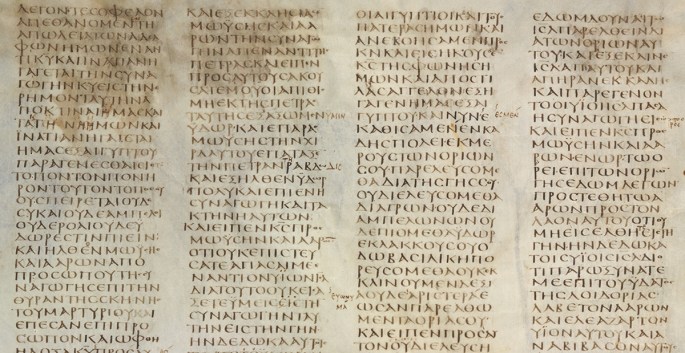
Did You Know That Ancient Greek Did Not Have Punctuation?

Ancient Greek, particularly during the New Testament period, lacked a formal punctuation system and spaces between words. Written in capital letters, texts relied on reader comprehension. The introduction of punctuation occurred centuries later, leading to varied interpretations in translations, which reflects translators' biases in rendering biblical texts with modern punctuation conventions.

The Rich Man and Lazarus by Edward Fudge

The following has been extracted from Edward Fudge's book Hell: A Final Word Blame it on the King James Version if you wish. The dangling fruit was so beautiful and far too close to resist. Imagine that you are a preacher and you have been requested to present a sermon on hell—“for the young folks,” … Continue reading The Rich Man and Lazarus by Edward Fudge

The Holy Spirit and Translation Bias: A Smoking Gun of Trinity Mischief

Author:- Sean Finnegan November 5, 2015 Translators have historically held incredible power to influence millions of Bible-readers over the eons. Many impressive developments have occurred in the field of textual criticism and lexicology over the last century. Today we can access dozens of English translations, Greek interlinears, and lexical aids online for free. In no … Continue reading The Holy Spirit and Translation Bias: A Smoking Gun of Trinity Mischief

The Holy Spirit is Missing from Paul’s Introductory statement in his Letters

There is an interesting regular introductory statement from Paul in all of his letters (except Hebrews) which has an obvious omission if your are a Trinitarian and believe that the Holy Spirit is a separate person. Paul writes in the beginning of each letter the statement “Grace to you (and sometimes mercy) and peace from … Continue reading The Holy Spirit is Missing from Paul’s Introductory statement in his Letters

“Melchizedek” is the Son of God

Christian interpreters have long been puzzled by the brief mention of Melchizedek in Genesis 14, his one-sentence mention in Psalm 110:4, and by the interpretation of those two texts by Paul in Hebrews 5&7. Most Christian commentators hold that Melchizedek was just a man and that he merely prefigured Christ, being a type or comparative … Continue reading “Melchizedek” is the Son of God

The “Son of God” in Matthew, Mark and Luke

Trinitarians and Unitarians alike incorrectly associate the title “Son of God” with the Virgin birth. For Trinitarians, “God the Son” became “the Son of God” by means of the incarnation. Unitarians deny the incarnation and preexistence of the Son. The human Jesus was “the Son of God” only in an adopted sense. Both groups must … Continue reading The “Son of God” in Matthew, Mark and Luke

The Coexistence of Sovereignty and Free Will – Calvinism Series

God is sovereign, but that doesn’t lead to the philosophy of St. Augustine or John Calvin. God chooses to limit His sovereignty in the case of man’s free will. He has established a framework of natural laws and spiritual laws. His natural laws include the laws of physics. Everything in the universe obeys God’s natural … Continue reading The Coexistence of Sovereignty and Free Will – Calvinism Series