Question:- Trinitarians say that because Jesus the Christ was divine and human, His sacrificial death had infinite value, and thus could pay for the sins of everyone. If Christ gave up His deity and His age-enduring life to become human like us (per Philippians 2:7), was His death a sufficient ransom for all simply because … Continue reading Kenosis Answers The Question was Jesus Fully Human Just Like Us?
Category: Teaching
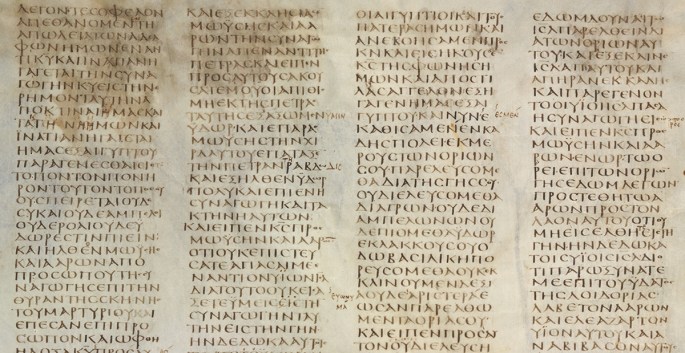
Did You Know That Ancient Greek Did Not Have Punctuation?
Ancient Greek, particularly during the New Testament period, lacked a formal punctuation system and spaces between words. Written in capital letters, texts relied on reader comprehension. The introduction of punctuation occurred centuries later, leading to varied interpretations in translations, which reflects translators' biases in rendering biblical texts with modern punctuation conventions.
Defining Elohim in the Biblical Context
by Paul Sumner hebrew-streams.org The word most often used for God in the Hebrew Bible is Elohim. The word is a topic of frequent theological discussion and defining. But what is often lacking is accurate and detailed information based on the biblical contexts in which the word is found. Elohim Section A — Summary of … Continue reading Defining Elohim in the Biblical Context
Philosophy & Methodology for Understanding Scripture
By Tim WarnerCopyright © The Pristine Faith Restoration Society The Pristine Faith Restoration Society believes that the foundational philosophies for discovering God's truth of the Catholic, Orthodox, and Protestant Churches are all seriously flawed. We realize that every Christian organization and denomination claims to hold to the original Christian Faith. But, with the extensive variety … Continue reading Philosophy & Methodology for Understanding Scripture
Life, Death and Resurrection in the Pauline Epistles
Acts 24:21 unless it is for this one statement which I cried out, standing among them, 'Concerning the resurrection of the dead I am being judged by you this day.' Many verses in Paul's epistles are often cited to prove he taught that man has an immortal soul which would depart upon the death of … Continue reading Life, Death and Resurrection in the Pauline Epistles
Introduction to Ancient Hebrew
By Jeff A. Benner If you were given the choice of a fast food meal or one from a 5 star restaurant, which one would you chose? Both restaurants provide food, but I think most people would choose the 5 star restaurant as it provides, better food and a better atmosphere than a fast food restaurant. … Continue reading Introduction to Ancient Hebrew
Why does Matthew use “the Kingdom of Heaven and not Kingdom of God”?
If we were to look for one single theme that seems to be the most central and most important theme of the entire gospel of Matthew, it would be the theme of the coming of the kingdom. We see in the first instance that the term gospel refers to the gospel of the kingdom — … Continue reading Why does Matthew use “the Kingdom of Heaven and not Kingdom of God”?
Inconsistent Translation of Hebrew Words for example “Heart”
by Jeff A. Benner I am often asked why my definitions of Biblical Hebrew words differ from all other resources available such as Strong’s dictionary and why my translations of the Bible are unlike any other English translation. Most people believe that an English translation of the Bible is a fairly good representation of the … Continue reading Inconsistent Translation of Hebrew Words for example “Heart”
The First Resurrection in Revelation
Copyright © Tim Warner Revised September 11, 2007 In Revelation 20, John described the resurrected saints seated on thrones and reigning with Christ after having been resurrected. Revelation 20:4-6 And I saw thrones, and they sat on them, and judgment was committed to them. Then I saw the souls of those who had been beheaded … Continue reading The First Resurrection in Revelation
About Hebrew Parallelism called Chiasmus which equates to Poetry
By Jeff A. Benner As Hebrew poetry is written much differently than our own Western style of poetry, many do not recognise the poetry which can cause problems when translating or interpreting passages written in poetry. Approximately 75% of the Hebrew Bible is poetry. All of Psalms and Proverbs are Hebrew poetry and many other books, … Continue reading About Hebrew Parallelism called Chiasmus which equates to Poetry