We all have Theological Filters

By Jeff A. Benner A filter, such as the air filter in your car, is used to block unwanted debris, yet allow air to continue through to the engine. A theological filter works in much the same way, it is a mental filter that blocks unwanted information, yet allows the desired information to continue through to … Continue reading We all have Theological Filters

What is Hebrew chiasm / chiastic / chiasmus structure in the Bible?

A chiasm (also called a chiasmus) is a literary device in which a sequence of ideas is presented and then repeated in reverse order. The result is a “mirror” effect as the ideas are “reflected” back in a passage. Each idea is connected to its “reflection” by a repeated word, often in a related form. The … Continue reading What is Hebrew chiasm / chiastic / chiasmus structure in the Bible?

Were Samuel, Moses & Elijah, Abraham, Isaac and Jacob – Alive Before the Resurrection?

Were Samuel, Moses & Elijah, Abraham, Isaac and Jacob - Alive Before the Resurrection? Three passages of Scripture are sometimes advanced in support of the view that the dead are alive before the resurrection. 1. The episode related in 1 Samuel 28 concerns a so-called appearance of Samuel after his death. There are good reasons … Continue reading Were Samuel, Moses & Elijah, Abraham, Isaac and Jacob – Alive Before the Resurrection?

A Logical look at The Rapture & the Timing

The only way in which the force of the above can be avoided is by saying that none of the descriptions of conflict affect the Church but only Jews who come to faith after the tribulation begins. We could then ask: If Jesus does not mean Christians when he says “you” in Matthew 24, how would we know that anything in the gospels addressed to “you” (disciples) applies to Christians? The theory that Christians are not addressed in Matthew 24:15ff (instructions for going through the great tribulation) sounds very much like an attempt to divorce Christians from what Jesus taught them in the gospels — indeed some ultra-dispensationalists have maintained that none of the material in the Synoptics (Matthew, Mark, Luke) is for Christians! When Jesus tells the twelve to go into the world and preach everywhere we all take this as a command to us. It was given to Jewish Christians but the body of Christ constitutes their descendants. What is said to them applies directly to us. When Jesus addresses believers telling them how to cope during the tribulation, this must mean that they must expect to be on earth during the tribulation.

When is the Rapture is really a Question about when the dead are Resurrected

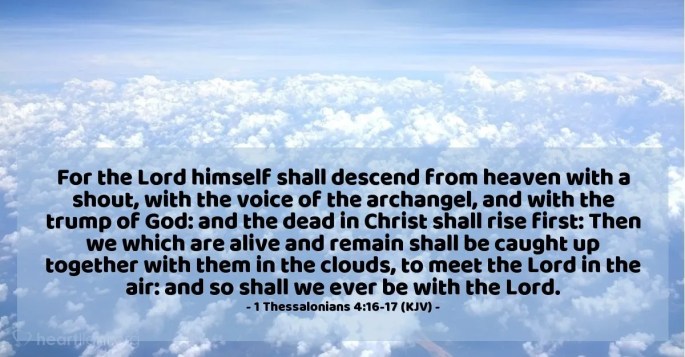
1. The Rapture/Resurrection event will occur at the last trumpet. Scripture knows of only one last trumpet, the seventh trumpet of Revelation 11:15. This trumpet sounds after or “post”-tribulation (Matthew 24:29-31). This is “the resurrection of the just” (Luke 14:14), when all the faithful will be rewarded. 2. Jesus spoke of the “elect,” whom he equates with the disciples and their successors in the church. Matthew, who is his own best interpreter, elsewhere means “believers” when he uses the term “elect” (Matthew 22:14): “Many are called, but few are elect” (Gr. eklectos). It is a basic rule of good exegesis that a writer must be allowed to interpret himself.

A Biblical Soul (Nephesh) is the whole Person including the Body

The Biblical Concept of “Soul” We proceed now to an examination of the Biblical concept of “soul.” It is our understanding of this term which will condition our understanding of the state of man in death. The foundation of the Biblical anthropology is laid in Genesis 2:7: “The LORD God formed man of the dust … Continue reading A Biblical Soul (Nephesh) is the whole Person including the Body

What and When are the First and Second resurrections in the Bible?

There are various beliefs about the two biblical resurrections mentioned in the bible based on what other doctrines the Christian believes. E.g. Pre-Tribulation or Post-Tribulation. About when they happen, who is involved in each one and why they happen. Even in Paul’s day the Greeks mocked him for his speech in Acts 17 in which … Continue reading What and When are the First and Second resurrections in the Bible?

Demystify the Meaning of Sheol and Hades in the Bible

Introduction In our English bibles Sheol (Hebrew) and Hades (Greek) are seen as only something physical. However that is not how the Jews understood these terms. Christians today use words like hell, Hades, Sheol and Gehenna interchangeably but they are not the same. This post will address the difference between Sheol and Hades as they … Continue reading Demystify the Meaning of Sheol and Hades in the Bible

The First Resurrection in Revelation

Copyright © Tim Warner Revised September 11, 2007 In Revelation 20, John described the resurrected saints seated on thrones and reigning with Christ after having been resurrected. Revelation 20:4-6 And I saw thrones, and they sat on them, and judgment was committed to them. Then I saw the souls of those who had been beheaded … Continue reading The First Resurrection in Revelation

Greek Philosophy’s Impact on our Understanding of Death

Much has been written on the subject of death, primarily because so many Christians have been led to believe that we don't really die but go on to live with Jesus in Heaven. In John W. Schoenheit's book "The Christian's Hope,*" chapter 7, The Origin of Orthodoxy he says, The vast majority of Christian denominations … Continue reading Greek Philosophy’s Impact on our Understanding of Death