Copyright© Tim Warner - 12/2003 The place to begin with the so called "time texts," on which preterism rests, is the Great Temple Discourse (Luke 21) and the Olivet Discourse (Matthew 24, Mark 13). These are the passages where Jesus expounded His second coming in greatest detail, the time delay between his first and second … Continue reading Preterism – Time Texts in the New Testament
Category: Christian Teaching

Preterism Introduction
Copyright © Tim Warner - 011/2003 Preterism is the theory that all Bible prophecy has been fulfilled. The second coming, resurrection, and last judgment, have been fulfilled in a mystical sense in AD70 — the destruction of Jerusalem. According to preterists, we are now living in the "New Heaven and New Earth." The resurrection is … Continue reading Preterism Introduction
Paul & the Mystery
Copyright © Tim Warner “Paul himself also — after that the Lord spoke to him out of heaven, and showed him that, in persecuting His disciples, he persecuted his own Lord, and sent Ananias to him that he might recover his sight, and be baptized — ‘preached,’ it is said, ‘Jesus in the synagogues at … Continue reading Paul & the Mystery

Which Commandments do We Keep?
Copyright © Tim Warner The "commandments of God" in Scripture have been a source of much confusion among Christians. Some claim that only Paul's teaching applies to us directly. Some claim that all "New Testament" commandments are for us. Others say some Old Testament commandments apply also. Others say all of the commands in Scripture … Continue reading Which Commandments do We Keep?

The Wheat and Tares Parable Speaks of 1 Rapture
Jesus used parables during His ministry to cover important truths. One of those truths was about the Kingdom of God that He would lead. The Wheat and Tares parable is the one of the Kingdom parables and has the most details and covers Jesus second coming. THE WHEAT AND TARES Matthew 13:24-3024 Another parable He … Continue reading The Wheat and Tares Parable Speaks of 1 Rapture

The Church in the Old Testament
Copyright © Tim Warner http://www.4windsfellowships.net Jesus & the Church in Psalm 22 The Greek word translated "Church" in the Bible is "ekklesia." It means "a called out assembly." It is found 112 times in the Greek New Testament. In all 112 cases, except Matthew 16:18, Acts 7:38, 1 Corinthians 10:32, Ephesians 1:22, Ephesians 3:10, Ephesians … Continue reading The Church in the Old Testament
Progressive Dispensationalism 102 An Overview
Copyright © Tim Warner The Old Covenant In the following diagrams, above the center line represents Israel, and below the line represents the Gentiles. Notice, in figure 1, Israel under the Old Covenant is divided into believers (light green) and unbelievers (tan). While the Scriptures still recognize all of the physical descendants of Jacob as … Continue reading Progressive Dispensationalism 102 An Overview
Progressive Dispensationalism 101 The Basics
Copyright © Tim Warner METHOD OF BIBLICAL INTERPRETATIONProgressive Dispensationalism maintains the literal (normal) method of biblical interpretation as the default hermeneutic. Progressive Dispensationalists also rely heavily on the New Testament writers' interpretations and applications of Old Testament prophecy. This is more than simply applying a 'model' of interpretation based on a 'style' established by the … Continue reading Progressive Dispensationalism 101 The Basics
Progressive Dispensationalism Introduction
Copyright © Tim Warner The Problem Even the casual student of Scripture is aware that the Old Testament and the New Testament present different approaches to how God deals with man. The Bible itself recognizes this. In John's prologue to his Gospel, he drew this distinction by saying, "the law was given by Moses, but grace … Continue reading Progressive Dispensationalism Introduction
What is Dispensationalism?
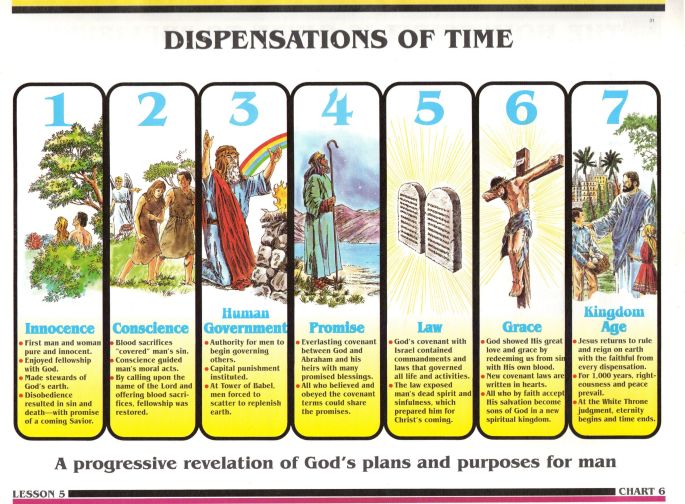
NB. This blog does not subscribe to standard dispensationalism. This post is made so that it can be understood and be helpful to viewers and will be used for other posts in a link. In the study of a compilation of 66 books written by 40 different authors over the course of 1500 years, it … Continue reading What is Dispensationalism?
 Living as a Christian in this World