Many Christians find it difficult to understand Jesus' parable about the rich man and Lazarus. Some believe that it is not a parable but a literal story. It is also supposed to support life after death. The one obvious issue is that the rich man has been judged and sent to Hades. The scriptures state … Continue reading Detailed look at Lazarus and the Rich man

Jewish Encyclopedia statement on Immortality Soul
Immortality of the Soul: http://www.jewishencyclopedia.com/articles/8092-immortality-of-the-soul “The belief that the soul continues its existence after the dissolution of the body is a matter of philosophical or theological speculation rather than of simple faith, and is accordingly nowhere expressly taught in Holy Scripture. As long as the soul was conceived to be merely a breath,1 and inseparably … Continue reading Jewish Encyclopedia statement on Immortality Soul

How many times is “Hell” mentioned in the Bible?
By Michael R. Burch How often does the word "hell" appear in the original Hebrew Bible, which constitutes the Old Testament of the Christian Bible? As the table below demonstrates, according to the consensus opinion of modern Bible scholars, the word "hell" as a place of eternal suffering was never mentioned, not even a single … Continue reading How many times is “Hell” mentioned in the Bible?

We all have Theological Filters
By Jeff A. Benner A filter, such as the air filter in your car, is used to block unwanted debris, yet allow air to continue through to the engine. A theological filter works in much the same way, it is a mental filter that blocks unwanted information, yet allows the desired information to continue through to … Continue reading We all have Theological Filters

What is Hebrew chiasm / chiastic / chiasmus structure in the Bible?
A chiasm (also called a chiasmus) is a literary device in which a sequence of ideas is presented and then repeated in reverse order. The result is a “mirror” effect as the ideas are “reflected” back in a passage. Each idea is connected to its “reflection” by a repeated word, often in a related form. The … Continue reading What is Hebrew chiasm / chiastic / chiasmus structure in the Bible?

Were Samuel, Moses & Elijah, Abraham, Isaac and Jacob – Alive Before the Resurrection?
Were Samuel, Moses & Elijah, Abraham, Isaac and Jacob - Alive Before the Resurrection? Three passages of Scripture are sometimes advanced in support of the view that the dead are alive before the resurrection. 1. The episode related in 1 Samuel 28 concerns a so-called appearance of Samuel after his death. There are good reasons … Continue reading Were Samuel, Moses & Elijah, Abraham, Isaac and Jacob – Alive Before the Resurrection?

A Logical look at The Rapture & the Timing
The only way in which the force of the above can be avoided is by saying that none of the descriptions of conflict affect the Church but only Jews who come to faith after the tribulation begins. We could then ask: If Jesus does not mean Christians when he says “you” in Matthew 24, how would we know that anything in the gospels addressed to “you” (disciples) applies to Christians? The theory that Christians are not addressed in Matthew 24:15ff (instructions for going through the great tribulation) sounds very much like an attempt to divorce Christians from what Jesus taught them in the gospels — indeed some ultra-dispensationalists have maintained that none of the material in the Synoptics (Matthew, Mark, Luke) is for Christians! When Jesus tells the twelve to go into the world and preach everywhere we all take this as a command to us. It was given to Jewish Christians but the body of Christ constitutes their descendants. What is said to them applies directly to us. When Jesus addresses believers telling them how to cope during the tribulation, this must mean that they must expect to be on earth during the tribulation.
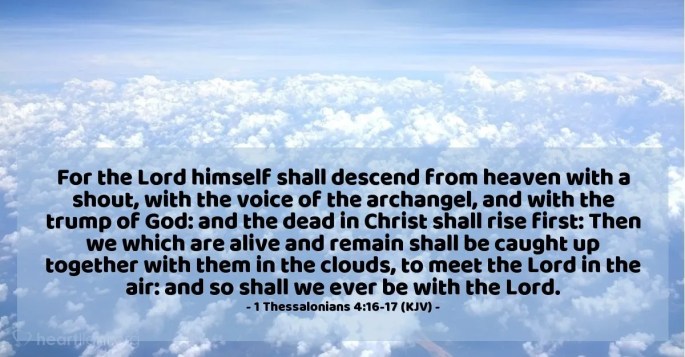
When is the Rapture is really a Question about when the dead are Resurrected
1. The Rapture/Resurrection event will occur at the last trumpet. Scripture knows of only one last trumpet, the seventh trumpet of Revelation 11:15. This trumpet sounds after or “post”-tribulation (Matthew 24:29-31). This is “the resurrection of the just” (Luke 14:14), when all the faithful will be rewarded. 2. Jesus spoke of the “elect,” whom he equates with the disciples and their successors in the church. Matthew, who is his own best interpreter, elsewhere means “believers” when he uses the term “elect” (Matthew 22:14): “Many are called, but few are elect” (Gr. eklectos). It is a basic rule of good exegesis that a writer must be allowed to interpret himself.

A Biblical Soul (Nephesh) is the whole Person including the Body
The Biblical Concept of “Soul” We proceed now to an examination of the Biblical concept of “soul.” It is our understanding of this term which will condition our understanding of the state of man in death. The foundation of the Biblical anthropology is laid in Genesis 2:7: “The LORD God formed man of the dust … Continue reading A Biblical Soul (Nephesh) is the whole Person including the Body
Hearing the Text of the Bible and not something else
One of our human frailties is our inability to hear the text of Scripture. More precisely, we have difficulty in hearing what the Bible says when we have been propagandized into a different opinion. We then start with a fixed notion and enter a kind of "denial" when we read verses which obviously conflict with … Continue reading Hearing the Text of the Bible and not something else
 Living as a Christian in this World